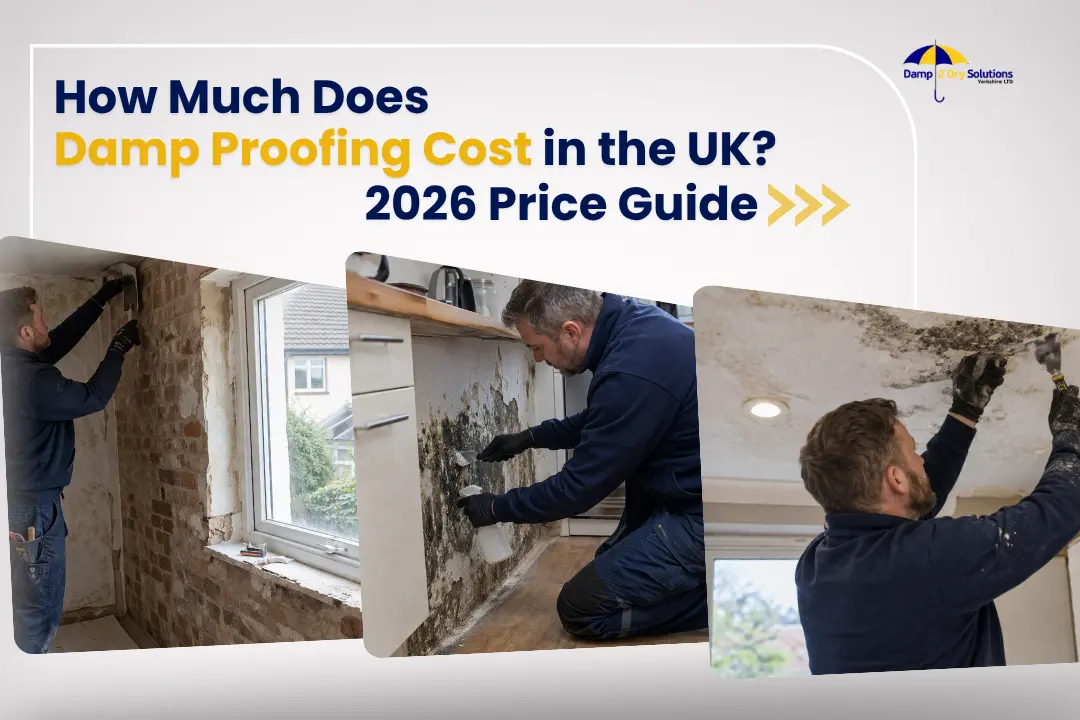
Damp proofing is so common in the UK that many homeowners assume it is almost inevitable. From older terraces to modern homes with ventilation issues, damp shows up in different forms, and the first question is always about cost.
The problem is, quotes can vary dramatically. One person might be told £300, while another hears £5,000 for what seems like the same issue. That confusion makes it difficult to know what is fair.
Whether you need urgent repairs or are planning a long-term fix, this guide breaks down realistic 2026 costs, what drives pricing, and how to understand quotes properly before making a decision.
How Much Does Damp Proofing Cost in the UK in 2026? (Quick Answer)
Here is a quick snapshot of average damp proofing costs across the UK:
| Type of Work | Average Cost (UK) |
| Damp survey | £200 – £300 |
| Chemical DPC injection | £500 – £1,200 |
| Internal replastering (per room, post-DPC) | £450 – £800 per room |
| Rising damp treatment (full wall, inc. replastering) | £500 – £2,500 (depending on re-plastering) |
| Basement waterproofing | £1,000 – £3,000 (small); £5,000 – £9,000 (large) |
Source: UK Calculator, MyBuilder, MyJobQuote
Most UK homeowners typically spend between £800 and £3,000, depending on the severity of the damp issue and the type of treatment required. Smaller problems, such as isolated damp patches, may fall at the lower end, while structural or widespread damp can quickly push costs higher.
What Type of Damp Are You Paying to Fix?
Before looking at treatment costs, it is important to understand that not all damp problems are the same. The type of damp directly influences how much you will pay.
Rising Damp
Rising damp is one of the more expensive types to treat because it often involves installing or repairing a damp proof course and then restoring internal finishes. Costs can range from £2,000 to £6,000 depending on the length of affected walls and the extent of damage. Replastering is usually required, which adds significantly to the total.
Penetrating Damp
Penetrating damp varies widely in cost because it depends on the source. If the issue is caused by something simple like faulty pointing or guttering, the cost may be relatively low. However, structural repairs to walls or roofing can increase the total considerably.
Condensation
Condensation is generally the least expensive to address. Solutions often involve improving ventilation, installing extractor fans, or adjusting heating patterns. Costs can range from a few hundred pounds to around £1,500, depending on the setup required.
Damp Proofing Costs by Treatment Type (Detailed Breakdown)
Chemical Damp Proof Course (DPC Injection)
This is one of the most common treatments for rising damp. It involves injecting a chemical barrier into walls to prevent moisture from rising. Costs typically range from £70 to £120 per metre. It is suitable for properties where the original damp proof course has failed or is missing.
Damp Proof Membranes
Membranes are used in more severe cases where moisture penetration is significant. These systems create a physical barrier and are often installed alongside other treatments. They are more expensive but offer long-term protection.
Replastering & Internal Finishes
Many homeowners underestimate this cost. After damp treatment, damaged plaster must be removed and replaced with a moisture-resistant finish. At £30 to £70 per m², this can add a substantial amount to the overall bill.
Basement Tanking / Waterproofing
Basement waterproofing is among the most expensive damp-proofing solutions. Costs start around £3,000 and can exceed £15,000 depending on the size and condition of the space. This is because it involves sealing entire areas against water ingress, often requiring specialist systems.
What Actually Drives the Cost Up or Down?
Damp proofing costs are not fixed because every property presents a different combination of conditions. Understanding these factors helps explain why quotes can vary so widely.
- Size of the affected area is the most obvious driver. A small patch on one wall may only need limited treatment, while damp running across multiple rooms increases material use, labour time, and finishing work such as replastering. Costs scale quickly when the issue spreads beyond a single wall.
- Severity of damp matters just as much. Early-stage damp might only require targeted treatment, but long-standing moisture often damages plaster, salts, and even structural elements. In such cases, contractors need to strip walls back, treat deeply, and rebuild surfaces, which adds both time and cost.
- Accessibility can significantly impact labour. Ground-floor walls are straightforward, but basements, tight spaces, or areas behind fitted units require more effort, specialist tools, and longer working hours.
- Property age and construction type also influence pricing. Older UK homes, especially Victorian or pre-1920 builds, often lack modern damp protection or use breathable materials that require careful handling. This can limit treatment options and increase complexity.
- Internal damage is often where costs rise unexpectedly. Damp rarely stops at the surface. Skirting boards, timber joists, flooring, and plaster may all need replacing, turning a simple treatment into a broader repair project.
- Finally, location plays a role. Labour costs in London and the South East are typically higher than in the North, meaning the same job can be priced differently depending on where the property is located.
Cost Per Room vs Cost Per Wall
Damp proofing costs vary depending on how the contractor structures the quote, which is why comparing estimates can feel confusing.
- Per metre pricing (DPC injection): £70 to £120 per linear metre. This usually covers drilling and injecting the damp proof course only. It often excludes plaster removal and redecoration, so the final cost can be higher.
- Per wall pricing: £800 to £2,500 per wall, depending on height, thickness, and level of damage. This may include partial replastering, but not always full restoration.
- Full-room pricing: £1,500 to £4,000 for a standard room, typically covering treatment, plaster removal, re-rendering, and finishing work.
Two quotes may look completely different because one includes full remedial work while another only addresses the source of damp. Understanding what is included is key before comparing prices.
Hidden Costs Most Homeowners Don’t Expect
Damp proofing costs are not always limited to the treatment itself. Several additional expenses can significantly increase the total if they are not included in the original quote.
- Plaster removal and replacement: £30 to £70 per m². A full room can easily add £500 to £1,500 depending on wall area.
- Skirting boards and joinery repairs: £100 to £400 per room, especially if timber has absorbed moisture or warped.
- Waste disposal (skip hire): £150 to £300 depending on the volume of removed plaster and debris.
- Redecoration after treatment: £200 to £800 for painting and finishing once walls have dried.
- Drying time delays: Not a direct cost, but can lead to temporary accommodation or delayed renovations, adding indirect expenses.
- Structural or timber repairs: £300 to £2,000+ if damp has affected joists, flooring, or internal woodwork.
These costs often turn a basic treatment into a much larger project, making it essential to understand what your quote actually includes.
Damp Survey Costs
A professional damp survey typically costs between £150 and £350. While some contractors offer free quotes, these are often tied to their services.
An independent survey provides a more objective assessment. It helps identify the exact cause of damp, ensuring the correct treatment is applied.
Accurate diagnosis is critical. Without it, there is a risk of paying for work that does not solve the problem.
Difference Between Cheap vs Professional Damp Proofing
Lower quotes can be appealing, but they often come with trade-offs.
| Cheap service | Professional service | |
| Coverage | Partial area only | Full affected area treated |
| Diagnosis | May misidentify damp cause | Accurate root-cause assessment |
| Replastering | Often skipped | Included |
| Upfront cost | Lower | Higher |
| Long-term cost | Higher (recurring issues) | Lower (lasting results) |
| Reliability | Inconsistent | Dependable |
While a lower quote may seem attractive, cheaper damp proofing often cuts corners, treating only part of the problem and skipping essential steps like replastering. This typically leads to damp returning, costing more to fix later.
A professional service costs more upfront but correctly identifies the source, treats it fully, and delivers results that last.
How to Estimate Your Damp Proofing Cost (Simple Framework)
You can build a rough estimate before speaking to any contractor by working through four simple steps.
Step 1: Identify the type of damp
The type of damp you have is the biggest cost driver. Rising damp requires DPC injection and replastering. Penetrating damp depends heavily on the source, a blocked gutter costs far less to fix than a failing wall. Condensation is usually the cheapest to address. Basement damp is in a category of its own and almost always requires a specialist.
Step 2: Measure the affected area
Walk the affected walls and note the linear metres. Count the number of rooms involved. These two numbers directly determine your treatment and replastering costs.
Step 3: Match with the right treatment and apply average pricing
Use these figures as a starting point:
- DPC injection: £70 to £120 per linear metre
- Replastering: £450 to £800 per room
- Penetrating damp treatment: £80 to £150 per linear metre
- Condensation / ventilation: £200 to £600 per room
- Basement waterproofing: £1,000 to £15,000 depending on size and severity
Step 4: Add the costs most homeowners forget
A realistic estimate includes more than just the treatment. Add skip hire (£150 to £300), redecoration (£200 to £800 per room), and a professional damp survey (£150 to £350). These often add £500 to £1,500 to the total.
To show how this works in practice, here is a real-world scenario.
A homeowner notices tide marks and peeling paint low on two walls in the living room. A damp surveyor confirms rising damp across 6 linear metres. The walls require full DPC injection and replastering. The property is in Manchester, so labour rates are slightly below the national average.
| Cost item | Estimated cost |
| Professional damp survey | £200 |
| DPC injection (6 m at £70–£100/m) | £420 – £600 |
| Replastering (1 room) | £450 – £800 |
| Skip hire / waste disposal | £200 |
| Redecoration after drying | £250 – £400 |
| Total estimate | £1,520 – £2,200 |
This is a realistic budget for a moderately affected single room. If the damp had spread to a second room, or if timber joists or skirting boards needed replacing, the total could easily rise to £3,000 or more.
UK Regional Price Differences for Damp Proofing & Other Services
Costs can vary depending on location. Labour rates in southern regions, particularly around London, are typically higher than in northern areas. Material costs are generally consistent, but labour can make a noticeable difference. This is why national averages should be used as a guide rather than a fixed expectation.
Here is a table explaining in detail:
| Region | Relative Cost vs UK Average | Typical DPC Injection (per metre) | Typical Rising Damp Treatment (full |
| London | +20% to +40% | £85 – £125 | £2,000 – £4,500 |
| South East & East | +10% to +20% | £75 – £100 | £1,800 – £3,500 |
| South West | At or near average | £65 – £90 | £1,500 – £3,000 |
| Midlands | At or near average | £60 – £85 | £1,500 – £2,800 |
| North West & North East | 10–15% below average | £55 – £80 | £1,200 – £2,500 |
| Scotland | 10–15% below average | £55 – £80 | £1,200 – £2,500 |
| Wales | 10–15% below average | £55 – £75 | £1,200 – £2,300 |
Source: BookaBuilderUK, ProCalculator UK
These costs gives a very clear picture of how costs can also differ on where you need the services in. Hence, keep in mind that service cost can very based on multiple reasons.
FAQs
Q. How much does damp proofing cost per metre in the UK?
DPC injection usually costs between £70 and £120 per metre. The total depends on the length of the affected wall and whether additional work like replastering is required.
Q. Is damp proofing covered by insurance?
Most insurance policies do not cover damp proofing unless it is caused by a specific insured event, such as flooding or structural damage. General damp issues are usually considered maintenance.
Q. How long does damp proofing last?
A properly installed damp proof course can last 20 to 30 years or more. The lifespan depends on the quality of installation and ongoing property maintenance.
Q. What is the average cost of a damp survey?
A professional damp survey typically costs between £150 and £350. Independent surveys may cost more but offer unbiased assessments.
Q. Can damp come back after treatment?
Yes, if the underlying cause is not fully addressed. This is why correct diagnosis and proper treatment are essential.
Conclusion
Understanding damp proofing costs is not just about numbers. It is about knowing what you are paying for and why quotes can vary so much. From the type of damp to hidden repair costs, every factor plays a role in the final price.
Taking the time to assess your situation properly can help you avoid unnecessary expenses and ensure long-term results. If you are unsure where to start, getting expert advice makes all the difference.
At Damp Solutions, you can get a clear assessment and practical guidance for your property, helping you make the right decision with confidence.