
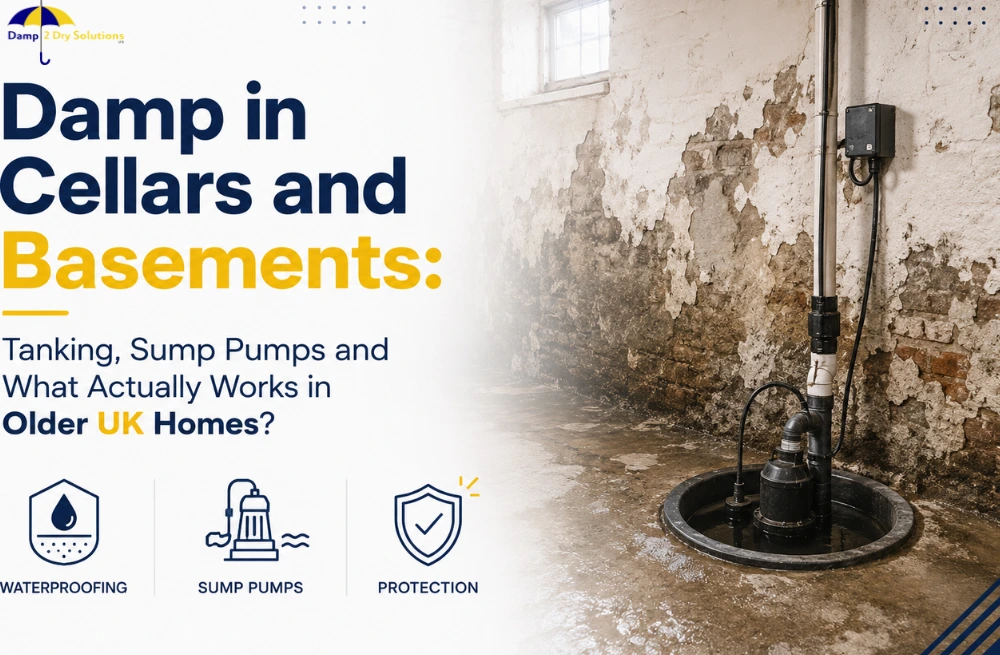
If you are researching basement damp proofing in the UK, chances are you are already dealing with peeling walls, musty smells, damp storage, mould growth, or even standing water in your cellar. And in older UK homes, the problem is rarely simple.
Older basements and Victorian cellars are more vulnerable because many were never designed to remain permanently dry under modern living conditions.
The problem is that most homeowners are sold generic damp treatments without understanding how older buildings in the UK were constructed. Tanking, membranes, drainage channels, and sump pump installation all work differently! And in the wrong property, the wrong solution can fail expensively.
Key Takeaways
Here are data-backed key takeaways for the blog, keeping them short, valuable, and naturally using the provided keywords:
- Cellar tanking cost in 2026 generally ranges between £90–£220 per m², depending on water severity, structural condition, and waterproofing system type.
- Type C cavity drainage systems often cost £8,000–£14,000 for a typical 40m² cellar.
- Modern sump pump installation UK projects usually cost £1,500–£3,500, while battery backups may add £300–£800 for stronger flood protection.
- Independent waterproofing surveys can help homeowners avoid costly mistakes by assessing groundwater risks, structural movement, and maintenance needs.
- Damp2DrySolutions helps homeowners identify cellar moisture issues correctly and supports long-term waterproofing strategies that reduce repeat failures and unnecessary costs.
Why Are Older UK Homes A Different Problem Entirely?
Older UK homes behave very differently from modern cavity-wall buildings. This is where many damp-proofing mistakes begin.
Most pre-1919 properties were built using:
- Solid brick or stone walls
- Lime mortar
- Breathable materials
- No damp-proof course (DPC)
- Natural moisture evaporation systems
These buildings were designed to “breathe.” Moisture moved slowly through walls and evaporated naturally through lime-based materials.
The problem starts when modern impermeable waterproofing systems are applied incorrectly to breathable structures.
In many cases, sealing moisture inside older masonry creates trapped moisture pressure, spalling brickwork, salt contamination, blown plaster, structural deterioration, or internal condensation.
A Damp cellar in victorian house is more common and requires specialist assessment rather than a generic damp survey.
How Climate Change Affects Damp in UK Homes?
Modern UK weather patterns are also changing the equation.
Rising groundwater levels, heavier rainfall events, urban drainage overload, and increased surface-water flooding are placing older basements under greater hydrostatic pressure than they were originally designed to withstand.
In dense urban areas, water tables are rising and surface drainage struggles during storms. Now more than ever, ground saturation lasts longer, and older drainage infrastructure has become overloaded.
This means many basements that historically remained “slightly damp” are now becoming actively wet. However, climate-related moisture problems are not affecting every property equally.
While newer homes can often adapt through upgraded drainage systems, waterproofing improvements, or structural modifications, older and heritage buildings face an additional challenge.
Many period properties operate under planning restrictions that limit how damp-proofing solutions can be installed, making basement waterproofing decisions significantly more complex.
Listed Buildings and Conservation Restrictions
For listed buildings or homes within conservation areas, waterproofing becomes even more complicated.
You often cannot:
- Remove historic flooring
- Apply certain external systems
- Alter original structural materials
- Introduce aggressive ventilation changes
This limits which waterproofing approaches remain compliant.
A qualified CSSW (Certified Surveyor in Structural Waterproofing) specialist becomes especially important in these cases because incorrect interventions can damage both the structure and the listed status.
These restrictions do not just affect project planning. They directly influence which waterproofing systems can realistically be used. One of the most widely used waterproofing methods in UK is tanking, particularly where internal moisture protection becomes a priority.
Tanking Explained: What is it and How it Works?
At its core, tanking attempts to stop water from entering the basement by creating a waterproof barrier across the inside face of walls and floors.
This is known as:
Type A Waterproofing
Common tanking systems include:
- Cementitious slurry coatings
- Waterproof renders
- Crystalline waterproof coatings
- Bitumen-based barriers
The principle sounds simple “Block water before it enters the room”.
Why Tanking Works Better in Modern Structures
In modern concrete basements, tanking can perform well because concrete remains relatively stable, the structures move less, substrates are predictable, and the moisture pressure is easier to manage.
This is why many new-build basements successfully use tanking systems.
Why Tanking Often Fails in Older UK Cellars?
Older masonry behaves differently. Solid brick and stone walls:
- Move slightly over time
- Retain salts and moisture
- Remain uneven
- Experience varying pressure points
Once hydrostatic pressure builds behind a tanked wall, the waterproof layer can eventually debond.
When this happens, water pressure begins forcing its way through weak points in the waterproofing system, increasing the risk of failure over time.
Protective coatings may crack, blister, or lose effectiveness, allowing moisture to bypass the barrier entirely. Once water intrusion starts, repairs often become far more disruptive, requiring additional work to identify the source and restore long-term protection.
In older UK properties, tanking often struggles when used alone against ongoing groundwater pressure. That is why reputable waterproofing specialists rarely recommend tanking as the only solution for a permanently wet cellar.
In some houses, sump pumps and cavity drainage are also successful!
Sump Pumps and Cavity Drainage
Modern waterproofing increasingly favours water management rather than total water exclusion. This approach is called:
Type C Waterproofing
Instead of trying to stop water from entering the structure entirely, Type C systems safely collect and redirect it away. This is generally considered the safest long-term approach for older UK basements.
How Cavity Drain Systems Work?
A cavity drain membrane creates a controlled gap between the internal wall and the living space. Any incoming moisture usually travels behind the membrane, enters drainage channels, flows toward a sump chamber, or gets pumped safely out of the property.
This method relieves hydrostatic pressure rather than fighting it directly.
Pedestal vs Submersible Sump Pumps
Pedestal Pumps
Pedestal pumps have their motor positioned above the water level, making them easier to access for servicing and maintenance. They are commonly used in lighter-duty drainage systems where water volumes are relatively low.
However, pedestal pumps are usually noisier during operation and are less commonly used in modern residential waterproofing projects because they offer lower capacity during heavy groundwater conditions.
Submersible Pumps
Submersible pumps are installed directly inside the sump chamber below the water level, allowing them to operate more quietly and efficiently. They are designed to handle larger water volumes and perform better during prolonged rainfall or high groundwater pressure.
Because of their reliability and stronger performance, most modern sump pump installation systems now use submersible pumps as the preferred solution for residential basement waterproofing.
Why Backup Systems Matter?
One overlooked reality: The pump only works while power and mechanics work.
If the pump fails during heavy rainfall, flooding can happen quickly, and even finished basements can suffer major damage.
This is why professional systems increasingly include:
- Dual-pump redundancy
- High-water alarms
- Battery backup units
- Backup power systems
Battery backups are particularly important during UK storm seasons when power outages and flooding often occur simultaneously.
Storage Cellar vs Habitable Basement
One of the biggest mistakes homeowners make during basement damp proofing is treating every cellar the same. A basement used occasionally for storage has very different waterproofing requirements compared to a fully converted living space, office, gym, or bedroom.
For example, a slightly damp storage cellar may only need basic moisture control and airflow improvements. But once the space becomes habitable, expectations change completely.
The environment must remain consistently dry, comfortable, and compliant with BS8102 waterproofing standards because people will spend extended time inside the room.
Have a clear understanding of occasional damp and active flooding to opt for the right treatment.
Occasional Damp vs Active Flooding
Not every damp basement requires the same level of intervention. Understanding the severity of water ingress is critical before choosing any waterproofing system.
Low-Level Damp
A basement with minor seasonal dampness or condensation may respond well to:
- Better ventilation
- Drainage improvements
- Localised waterproofing
- Humidity management
Active Water Ingress
If water actively enters through walls, floors, or joints during rainfall, the property usually requires:
- Type C cavity drainage systems
- Pressure management
- Sump pump systems
- Controlled water evacuation
Flood-Prone Basements
Properties with repeated flooding or high groundwater pressure often need far more protection, including:
- Dual waterproofing systems
- Backup sump pumps
- High-water alarms
- Ongoing servicing and maintenance plans
What Does It Actually Cost in 2026?
Costs vary dramatically depending on access difficulty, water severity, property age, drainage complexity, and structural condition.
Typical Cost Ranges
- Cellar Tanking Cost
Basement tanking cost in the UK varies widely in 2026, but most homeowners can expect to pay between £90 and £220 per square metre, depending on the system, condition of the structure, and level of water ingress.
Typical all-in rates for basement tanking cost in 2026:
- Simple slurry system on sound masonry: £90 to £140 per m²
- Advance barrier with renders and floor treatment: £120 to £170 per m²
- Full cavity membrane design with drainage: £120 to £220 per m²
For a 40 m² basement primarily intended for storage, a properly designed slurry waterproofing system may typically cost between £5,000 and £7,000. However, if the basement is being converted into a habitable living space with a high water table, it can range from £9,000 to £14,000.
- Type C Cavity Drain Systems
Cavity drain membrane system: £120 to £220 per m² (most reliable long-term solution).
Typical costs broken down:
- Membrane supply and fit: £60 to £100 per m²
- Drainage channels: £40 to £70 per metre
- Sump pump system: £1,500 to £3,500
For a typical 40 m² cellar, a full cavity membrane system with sump pump often lands between £8,000 and £14,000 all in.
- Sump Pump Installation UK
Sump pump systems: £1,500 to £3,500 depending on spec.
Electrical supply for the pump: a qualified electrician will usually charge £250 to £600, depending on complexity. Battery backup systems can add another £300 to £800 but are often worthwhile in areas prone to power cuts.
A dual pump setup with battery backup is often specified in high-risk zones to maintain protection during power cuts.
Source: BookabuilderUK
What Drives Costs Higher in Older Homes?
Older properties often involve fragile masonry, uneven substrates, drainage routing challenges, structural repairs, and salt contamination cleanup.
These complexities increase labour and preparation costs significantly. Moreover, hidden structural issues, ageing materials, drainage limitations, and previous repair work can change project requirements significantly.
This means pricing decisions should never rely on assumptions alone, but on an independent survey!
Why Independent Surveys Matter?
One of the smartest investments is paying for an independent waterproofing survey before accepting contractor quotes.
A good survey should reference:
- BS8102 standards
- Intended room use
- Groundwater risk
- Structural movement
- Long-term maintenance requirements
Red Flags in Waterproofing Quotes
Be cautious if quotes:
- Skip detailed surveys
- Ignore the intended basement use
- Mention only one system universally
- Ignore maintenance requirements
- Avoid discussing failure risks
When to Call a Professional?
DIY monitoring works for basic visual inspections, alarm checks, or minor maintenance. Professional servicing becomes necessary when water levels rise unexpectedly, pumps cycle constantly, odours appear, structural damp returns, or when flooding risk increases.
Final Words
There is no universal waterproofing solution for older UK basements.
The right solution depends on groundwater pressure, wall construction, intended use, drainage behaviour, and long-term maintenance planning.
In many older UK properties, modern waterproofing succeeds not by completely blocking water, but by safely managing it through properly designed drainage and pump systems.
Professional companies such as Damp2DrySolutions help homeowners assess cellar moisture problems properly before recommending waterproofing systems. We support and provide structural damp investigations and provide a long-term solution to prevent expensive repeat failures.
FAQs
What causes damp in cellars and basements in older UK homes?
Older UK homes often experience basement damp because many pre-1919 properties used breathable materials, lime mortar, and lacked damp-proof courses. Rising groundwater, trapped moisture, ageing masonry, and changing weather patterns can worsen basement damp.
What is basement tanking?
Basement tanking is a waterproofing method that creates a barrier on internal basement walls and floors to block water entry. Common systems include slurry coatings and waterproof renders. Cellar tanking cost depends on the property condition and moisture severity.
What is a Type C waterproofing system?
Type C waterproofing manages water rather than fully blocking it. A cavity drain membrane collects moisture behind walls and redirects it into drainage channels and pumps. This approach is often preferred for waterproofing basements.
How much does basement tanking cost in the UK?
Basement tanking cost in the UK generally ranges from £90–£220 per m². Cellar tanking cost varies based on structural condition, drainage complexity, and water ingress levels. Larger waterproofing projects can cost significantly more.
What is a sump pump and how does it work?
A sump pump removes collected groundwater from basements through drainage systems. Water enters a sump chamber and gets pumped safely away from the property. Modern sump pump installation commonly use submersible pumps for stronger long-term performance.
Why do older UK homes experience more basement damp?
Older homes were designed to breathe naturally through lime mortar and permeable materials. Modern waterproofing mistakes, ageing structures, rising groundwater, and drainage limitations make damp cellar Victorian house problems more common than in newer buildings.
Can climate change worsen basement damp problems?
Yes. Rising groundwater levels, heavier rainfall, overloaded drainage systems, and surface water flooding are increasing moisture pressure in older properties. Climate change can make basement damp proofing more challenging, especially in homes not built for modern flooding risks.