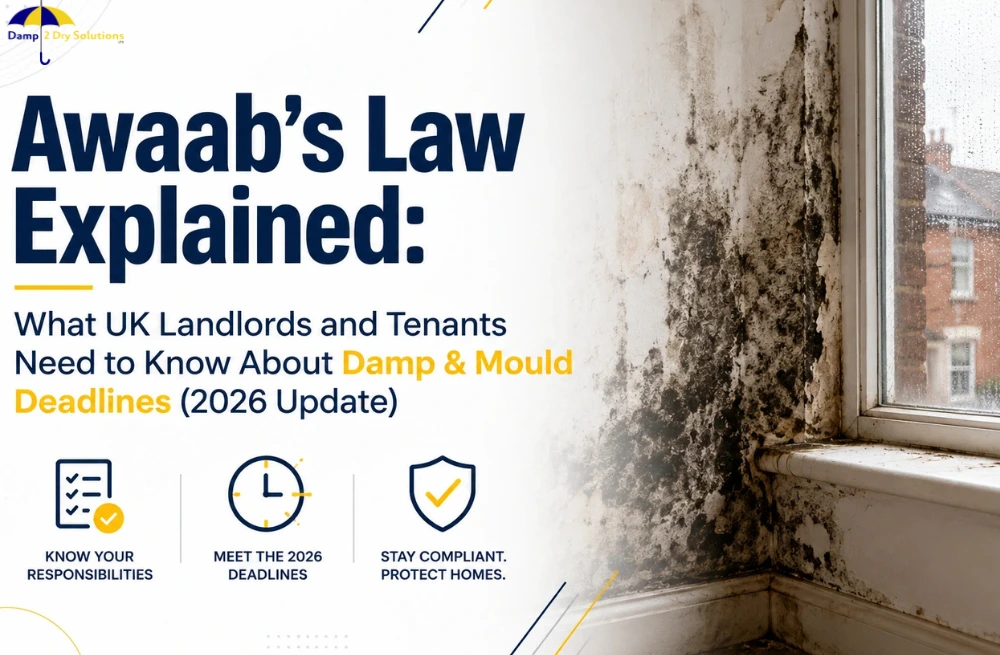
Damp and mould complaints in UK rental homes are no longer just “maintenance delays.” They have become a legal compliance issue with strict repair deadlines!
This shift came after the tragic death of two-year-old “Awaab Ishak” on 21 December 2020. It exposed major failures in the way damp and mould complaints were handled in social housing across the UK. The case sparked nationwide concern and intensified pressure on the government to strengthen tenant safety laws.
As a result, the government introduced stricter housing regulations defining damp and mould landlord responsibilities UK. In this blog, we will see what it is and why it was enforced.
Key Takeaways
- Awaab’s Law explained one of the biggest reforms in UK housing safety regarding damp and mould complaints.
- Under updated social housing damp regulations UK, landlords must follow the guidelines.
- The phased rollout between 2025 and 2027 expands damp and mould landlord responsibilities UK to fire safety, electrical hazards, structural risks, sanitation issues, and wider HHSRS compliance requirements.
- Updated tenant rights damp and mould 2026 protections now give tenants stronger escalation rights through councils and the Housing Ombudsman.
- You can read responsibilities and guidelines under Awaab’s Law in the blog.
Awaab’s Law Explained as a Major Reform in Social Housing
Awaab’s Law came into effect on October 27, 2025!
Awaab Ishak (Dec, 2020) passed away at Royal Oldham Hospital due to a severe respiratory condition. The condition was caused by prolonged exposure to mould in his home in Rochdale, Greater Manchester.
Investigations found that more than 850 out of RBH’s 12,000 homes had serious damp and mould problems. Reports by the BBC also revealed that the landlord took almost 2 years to begin checking other properties for similar issues.
To prevent such dangerous housing conditions, Awaab’s Law was introduced as part of the Social Housing Regulation Act 2023. It was formally implemented through the Hazards in Social Housing (Prescribed Requirements) (England) Regulations 2025.
Under the first phase, landlords must investigate serious damp and mould hazards within fixed timeframes and respond to emergency risks within 24 hours.
Additional housing hazards, such as fire safety, excess cold, structural risks, and electrical hazards, are being phased into the law during 2026 and 2027.
Actions Under Awaab’s Law Explained: All Phases (2025-2027)
Government reports show millions of renters face unsafe housing conditions. Nearly 60% of Housing Ombudsman complaints involve damp and mould issues. The reforms are designed to force faster landlord action, improve tenant safety, and prevent prolonged exposure to hazardous living conditions.
Each phase expands landlord responsibilities and strengthens tenant rights damp and mould 2026 protections across the housing sector.
Phase 1 (October 2025): Damp, Mould & Emergency Hazards
The first phase of Awaab’s Law officially came into force on 27 October 2025 and primarily focuses on dangerous damp, mould, and emergency repairs in social housing.
Under this phase, landlords must:
- Investigate emergency hazards within 24 hours
- Address serious damp and mould issues within fixed timelines
- Begin repair action quickly after inspections
- Maintain proper communication with tenants
- Keep records of complaints, inspections, and repairs
This phase directly strengthens damp and mould landlord responsibilities UK by making delayed responses a legal compliance issue instead of a maintenance choice.
Another major change is that landlords can no longer treat mould as a “tenant lifestyle issue” without conducting a proper investigation.
This phase mainly applies to social landlords in England, including housing associations, councils, and social housing providers.
Phase 2 (2026): Expansion to Wider Housing Hazards
The second phase (effective from October 2026) of Awaab’s Law goes beyond damp and mould. It includes a much broader set of housing hazards under the Housing Health and Safety Rating System (HHSRS).
Landlords must also respond within fixed timelines to hazards such as excess cold or heat, fire, electricity, structural collapse risks, hygiene and sanitation problems, etc.
This phase is significant because it transforms Awaab’s Law from a damp-and-mould regulation into a broader housing safety compliance framework under updated social housing damp regulations in the UK.
Phase 3 (2027): Full HHSRS Compliance Framework
The third phase, expected during 2027, significantly expands the scope of Awaab’s Law to cover almost all remaining hazards listed under the Housing Health and Safety Rating System (HHSRS).
Landlords will likely be legally required to investigate and resolve nearly all serious property safety risks within prescribed deadlines. This includes drainage issues, pest infestations, fall hazards, water supply risks, and any other additional environmental and structural safety hazards.
However, the government has clarified that overcrowding hazards are currently excluded from Awaab’s Law repair deadline requirements. But they remain controlled under separate housing legislation.
Moreover, the government has already signaled wider reforms for private rentals as well.
Expected Expansion Into the Private Rental Sector Under Awaab’s Law
Although Awaab’s Law currently applies mainly to social housing, the government has already indicated that similar requirements may expand into the private rented sector through future Renters’ Rights reforms.
This means future private landlord mould obligations may include:
- Fixed repair deadlines
- Mandatory inspections
- Faster damp investigations
- Legal communication requirements
- Stronger tenant enforcement rights
Private landlords are therefore advised to prepare compliance systems early instead of waiting for formal implementation.
What Landlords Are Required to Do Under Awaab’s Law
As part of Awaab’s Law explained, landlords now have strict legal duties under updated social housing damp regulations in the UK. They are required to:
- Investigate emergency hazards within 24 hours
- Inspect serious damp and mould complaints within fixed legal deadlines.
- Identify the root cause of mould, including leaks, poor ventilation, insulation failure, or structural damp.
- Complete repair work within the required timeframe after hazards are confirmed.
- Maintain written records of complaints, inspections, repair work, and tenant communication.
- Provide tenants with regular updates regarding repair progress and timelines.
- Consider vulnerable occupants such as children, elderly residents, and people with respiratory illnesses.
- Arrange temporary accommodation if the property becomes unsafe during repair work.
- Follow expanded damp and mould landlord responsibilities UK as the law phases further into 2026–2027.
What Tenants Are Required to Do Under Awaab’s Law
Under updated tenant rights damp and mould 2026 protections, tenants also have responsibilities to help ensure housing issues are addressed properly. They are expected to:
- Report damp, mould, leaks, or unsafe housing conditions as early as possible.
- Keep evidence of issues through photos, emails, messages, or medical records where relevant.
- Allow reasonable access for inspections, surveys, and repair work.
- Inform landlords if damp or mould returns after repairs are completed.
- Use ventilation and heating systems properly where reasonably possible.
- Cooperate during inspections, investigations, and temporary repair arrangements.
- Escalate unresolved complaints to local councils or the Housing Ombudsman if landlords fail to act within legal deadlines.
Challenges Landlords May Face While Complying With Awaab’s Law
-
Rapid Response Pressure
Under updated social housing damp regulations UK, landlords are expected to respond to serious hazards within legally defined timelines. This includes investigating emergency hazards within 24 hours, 10 days to investigate non-emergency cases, and 5 days to start repairs, according to the UK Government.
-
Shortage of Qualified Surveyors and Contractors
One growing challenge is the limited availability of experienced damp surveyors, ventilation specialists, and HHSRS-trained professionals.
-
Access Delays Inside Occupied Properties
Repairs often require repeated access to occupied homes for inspections, surveys, moisture testing, ventilation work, or structural repairs.
-
Increasing Compliance Costs
Landlords may need to invest in building upgrades, mould prevention systems, insulation improvements, temporary accommodation arrangements, legal compliance software, and emergency repair capacity.
-
Difficulty Managing Large Housing Portfolios
Housing associations and councils managing thousands of properties often lack updated condition data for every building. Without proactive inspections and digital property records, identifying high-risk homes and vulnerable tenants becomes much more difficult.
Operational & Legal Risks for Landlords
-
Higher Legal Exposure
Failure to comply with timelines under tenant rights damp and mould 2026 protections may lead to compensation claims, Housing Ombudsman investigations, enforcement notices, or court action.
-
Increased Public and Regulatory Scrutiny
After several high-profile housing cases across the UK, regulators and the Housing Ombudsman are now applying much closer scrutiny to landlord complaint handling. This includes inspection quality and repair timelines.
-
Pressure on Internal Communication Systems
Compliance often depends on coordination between repair teams, surveyors, legal departments, contractors, and tenant support officers. Delays in communication or poor record-sharing between departments can result in missed deadlines and incomplete repair actions.
The Bottom Line
Awaab’s Law has fundamentally changed how housing hazards are handled across the UK. Damp, mould, and unsafe living conditions are no longer treated as delayed “maintenance issues” but as serious health and compliance risks.
Effective as of October 27, 2025, the law places stricter responsibilities on landlords to investigate hazards quickly, maintain proper documentation, complete repairs within legal timeframes, and prioritise tenant safety.
As the legislation expands further into 2026 and 2027, both social housing providers and private landlords will need stronger compliance systems, faster repair processes, and more active property management practices to meet the housing safety standards in the UK.