

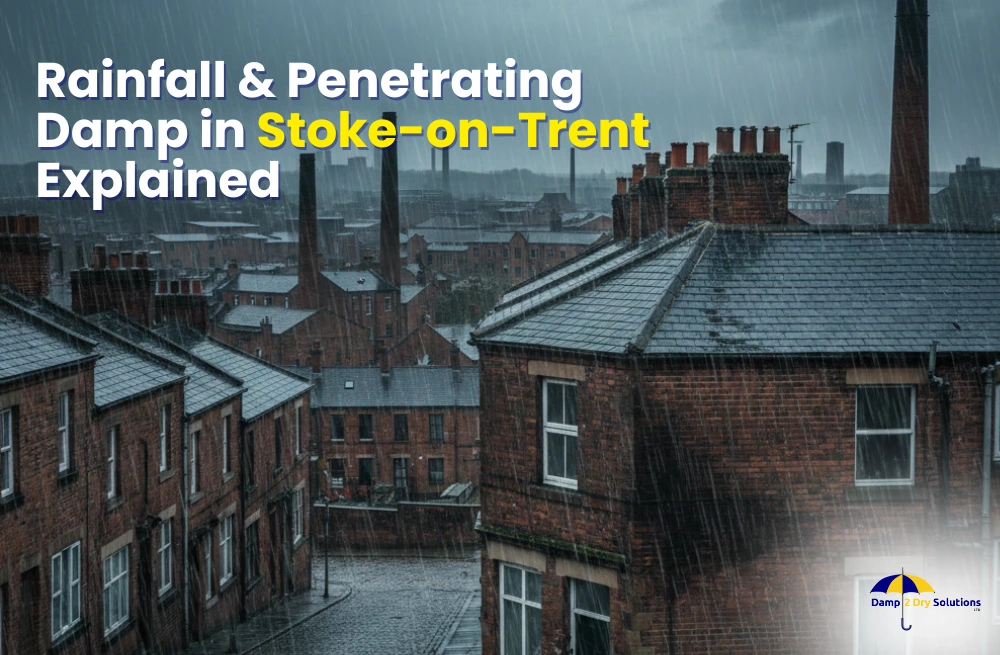
Stoke-on-Trent is no stranger to wet weather. Long spells of steady rain, heavy downpours during winter and wind-driven storms can all test the external fabric of a property. Many homeowners only notice damp patches appearing after a period of bad weather, which raises an important question:
Does Stoke-on-Trent’s rainfall increase the risk of penetrating damp?
The short answer is yes, but rainfall alone is rarely the sole cause. It usually exposes weaknesses that already exist in brickwork, pointing, roofing or drainage. Understanding how this works can help you spot early warning signs and avoid more serious structural issues.
What Is Penetrating Damp?
Penetrating damp happens when water enters a property through the external building fabric. Unlike rising damp, which moves upward from the ground, or condensation, which forms from internal moisture in the air, penetrating damp comes directly from outside.
It often appears as:
- Damp patches on external-facing walls
- Blown or crumbling plaster
- Peeling paint or wallpaper
- Dark staining that worsens after heavy rain
- Damp around chimney breasts or window reveals
The key difference is timing. If the damp area becomes darker after rainfall and improves slightly during dry spells, penetrating moisture is likely.
How Much Rain Does Stoke-on-Trent Receive?
Stoke-on-Trent experiences moderate to high annual rainfall compared with some southern parts of England. The issue is not just the total rainfall over a year. It is the pattern.
Extended periods of steady rain are more problematic than brief showers. When walls remain saturated for days at a time, moisture can find its way through cracks, failed pointing or porous brickwork.
Wind also plays a role. In exposed areas of Stoke, wind-driven rain can push water horizontally against walls, increasing the pressure on external surfaces. Over time, this repeated exposure can lead to moisture penetrating internally.
Rain does not create penetrating damp on its own. It exploits weaknesses that are already there.
Why Some Stoke Properties Are More Vulnerable
Not all homes respond to rainfall in the same way. The age and construction type of the property make a difference.
Victorian Terraces
Many parts of Stoke-on-Trent have older terraced housing built with solid brick walls and lime mortar. These properties were designed to breathe, but over time:
- Mortar joints can erode
- Brick faces can become porous
- Previous cement repointing can trap moisture
If the outer surface deteriorates, water can pass through the wall thickness and show internally.
1930s and Post-War Semis
Homes built in the 1930s and post-war years usually have cavity walls. In theory, cavities prevent water from crossing from the outer wall to the inner wall. However:
- Debris in the cavity can bridge moisture
- Wall ties can corrode
- Poorly fitted insulation can retain damp
If the cavity fails to perform properly, penetrating damp can develop.
Exposed and Elevated Areas
Properties on higher ground or open aspects around Stoke can experience stronger wind-driven rain. Chimney stacks, gable walls and bay windows are often first to show signs of water ingress.
Common External Causes of Penetrating Damp in Stoke
Rainfall reveals building defects. The most common causes we see in Stoke-on-Trent include:
1. Damaged or Eroded Pointing
Mortar joints naturally degrade over time. If gaps form, rainwater can travel directly into the wall structure.
2. Cracked Brickwork
Freeze-thaw cycles during winter can cause bricks to crack or spall, making them more absorbent.
3. Defective Roof Coverings
Missing or slipped roof tiles allow water into loft spaces and internal walls.
4. Faulty Flashing
Lead flashing around chimneys and roof junctions can fail, letting water seep into masonry.
5. Blocked or Overflowing Gutters
When gutters overflow during heavy rain, water cascades down external walls repeatedly, saturating brickwork.
6. Cracked Render
Render can develop hairline cracks over time. Once water enters, it may track behind the surface before showing internally.
Each of these issues may seem minor individually. During prolonged wet weather, they become significant.
How to Tell If Rainfall Is the Trigger
One of the clearest indicators is pattern.
Penetrating damp often:
- Worsens after sustained rainfall
- Appears on external-facing walls
- Forms irregular patches rather than a horizontal tide mark
- May dry partially in warmer, drier months
If you notice damp appearing only after storms or during winter periods of heavy rain, external water ingress is likely.
It is also worth checking whether the affected wall aligns with an external defect such as a gutter joint, roof valley or cracked pointing.
Can Persistent Rain Cause Long-Term Damage?
Yes. If penetrating damp is left unresolved, moisture can lead to wider issues.
Timber Decay
Wet masonry can transfer moisture to embedded timbers such as floor joists, leading to rot.
Plaster Failure
Gypsum plaster breaks down when repeatedly exposed to moisture, causing it to crumble or blister.
Heat Loss
Wet walls lose thermal efficiency. Damp masonry conducts heat more quickly, which can increase energy costs.
Mould Growth
Although penetrating damp is external in origin, persistent moisture can create conditions for mould to grow internally.
The longer water is allowed to enter unchecked, the more expensive the repair work may become.
Is It Always Penetrating Damp?
Not necessarily.
Some damp patches that appear after cold weather are caused by condensation, especially in rooms with poor ventilation. The difference lies in cause and pattern.
Condensation is typically:
- Surface-level
- Associated with black mould
- Worse in bathrooms, kitchens or bedrooms
- Linked to lifestyle and airflow
Penetrating damp, by contrast, often:
- Matches an external structural issue
- Shows after heavy rain
- Appears on exposed walls
A professional damp survey can determine the difference accurately.
Practical Steps for Homeowners in Stoke-on-Trent
There are sensible checks you can carry out yourself before assuming the worst.
- Inspect gutters during heavy rain
- Check for loose or missing roof tiles
- Look for cracks in external render
- Examine mortar joints for gaps
- Ensure downpipes discharge properly
Addressing minor external maintenance issues/DIY early can prevent internal damp from developing.
However, if damp persists despite these checks, further investigation is advisable.
When Should You Arrange a Damp Survey?
You should consider a survey if:
- Damp patches keep returning after rainfall
- Plaster continues to deteriorate
- There is a persistent musty smell
- You are buying or selling a property
- The cause of moisture is unclear
A proper survey involves inspecting external fabric, taking moisture readings and assessing ventilation and insulation performance. The aim is to identify the true cause rather than guessing.
Does Stoke’s Rainfall Increase Risk Overall?
Stoke-on-Trent’s rainfall does not automatically cause penetrating damp. What it does is increase exposure.
In properties where brickwork, pointing or roofing are already weakened, prolonged rainfall accelerates water ingress. In well-maintained homes, rainfall alone should not cause internal damp.
The key factor is condition, not just climate.
Final Thoughts
Rainfall is a natural part of living in Stoke-on-Trent. Most homes are built to withstand it. Problems arise when building materials deteriorate or maintenance is delayed.
If damp patches consistently appear after heavy rain, it is sensible to investigate further. Early identification of penetrating damp can prevent more serious structural damage and reduce long-term repair costs.
Understanding how local weather interacts with your property gives you an advantage. Damp rarely appears without a reason. The important step is identifying that reason correctly.
If you are experiencing damp problems locally, speak to our specialist team on our Damp Specialist Stoke-on-Trent page
Frequently Asked Questions About Rainfall & Penetrating Damp in Stoke-on-Trent
1. Can heavy rain cause damp inside walls?
Heavy rain can expose weaknesses in brickwork, pointing, render or roofing. If water finds a route through damaged external surfaces, it can lead to penetrating damp inside the property. Rain alone does not cause damp, but it can worsen existing defects.
2. How do I know if damp is caused by rain?
Damp linked to rainfall often becomes worse after prolonged wet weather and improves during dry periods. It usually appears on external-facing walls and may align with damaged gutters, cracked pointing or roof defects.
3. Is penetrating damp common in Stoke-on-Trent?
Penetrating damp can occur in Stoke-on-Trent, particularly in older terraced properties and homes exposed to wind-driven rain. Regular rainfall increases the importance of maintaining external brickwork and roofing.
4. Can penetrating damp dry out on its own?
If the external defect is minor and repaired quickly, affected areas may gradually dry out. However, if the source of water ingress is not addressed, damp is likely to return after further rainfall.
5. What is the difference between penetrating damp and rising damp?
Penetrating damp enters through external walls or roofs, often after heavy rain. Rising damp moves upward from the ground due to a failed damp proof course. The visible pattern and location of moisture are usually different.
6. Should I get a damp survey if patches appear after rain?
If damp patches consistently appear after rainfall, a professional damp survey can determine whether the cause is penetrating damp, condensation or another issue. Early diagnosis helps prevent more serious structural damage.