
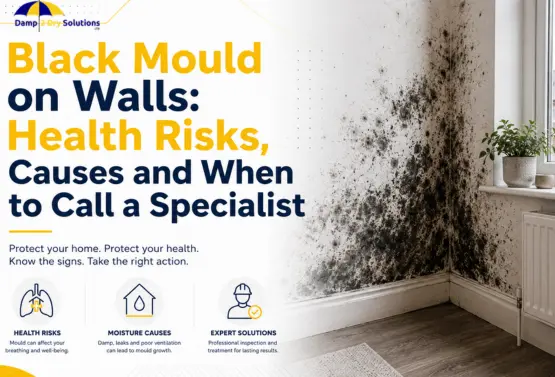
Black Mould on Walls is one of the most common signs of excess moisture inside a property, yet many homeowners and tenants dismiss it as a minor cosmetic problem.
In reality, those dark patches can indicate ongoing damp issues that affect both the condition of your home and the health of the people living in it. Left untreated, mould can spread quickly, damage building materials, and release spores into the air.
Under Awaab’s Law, which came into force for social housing in October 2025, landlords are required to investigate and address damp and mould hazards within strict timeframes when they pose a risk to tenants’ health. The legislation reinforces a growing understanding that mould is not simply a maintenance concern but a matter of public health.
Let us see the causes, health risks, and when we should call a specialist!
Key Takeaways
- Black mould is usually a sign of excess moisture caused by condensation, leaks, penetrating damp, or rising damp. Treating the moisture source is essential for long-term prevention.
- Back mould on walls health risks include respiratory problems, allergies, asthma flare-ups, and irritation of the eyes, nose, throat, and skin, particularly among vulnerable individuals.
- Mould on bedroom walls commonly develops behind beds and wardrobes placed against cold external walls, where airflow is limited and condensation can build up.
- Cleaning visible mould may provide temporary relief, but mould often returns if the underlying damp issue is not identified and resolved.
- Damp2Dry Solutions helps homeowners and landlords identify the root cause of damp and mould through professional surveys and tailored remediation solutions, ensuring a healthier, drier, and mould-free property.
What Black Mould on Walls Actually Is?
Black mould is not a single species of fungus but a general term used to describe dark-coloured moulds that grow indoors when excess moisture is present.
These microscopic fungi reproduce by releasing spores into the air, which settle on damp surfaces and multiply when conditions are favourable. While mould plays an important role in nature by breaking down organic matter, its presence inside homes can raise concerns about indoor air quality and potential health effects.
How to Identify Black Mould?
Black mould typically appears as dark green, brown, or black patches on walls, ceilings, window sills, or other surfaces exposed to persistent moisture. In the early stages, it may look like small speckles or stains, but over time, it can spread into larger clusters.
One of the most noticeable signs is a persistent musty or earthy odour. This smell is caused by microbial volatile organic compounds (MVOCs) released as mould grows and can sometimes be detected even before visible mould appears.
In UK homes, mould is most commonly found in areas where moisture accumulates and airflow is restricted, including:
- Cold external walls where condensation forms
- Behind wardrobes, sofas, and other large furniture placed against outside walls
- Bathroom corners exposed to steam and humidity
- Kitchens with poor ventilation
- Window frames and window reveals
- Bedrooms with limited airflow and high indoor humidity
Is All Black Mould the Same?
A common misconception is that every black-coloured mould is the infamous “toxic black mould.” In reality, several different mould species can appear black, and colour alone cannot determine how harmful a mould may be.
The species most often associated with the term “toxic black mould” is Stachybotrys chartarum. This mould typically grows on water-damaged materials such as plasterboard, drywall, wallpaper, and timber that have remained damp for extended periods. It can produce substances known as mycotoxins under certain conditions, which has led to widespread public concern.
However, Stachybotrys chartarum is not the only black mould found in homes. Other common indoor moulds include:
Aspergillus niger
A dark-coloured mould frequently found in damp buildings, dust, food products, and ventilation systems. It is one of the most commonly identified indoor mould species.
Alternaria
Often found around windows, bathrooms, showers, and damp walls. Alternaria spores are recognised allergens and can trigger symptoms in people with allergies or asthma.
Is Black Mould Dangerous?
Many people assume mould is simply an unsightly household problem, but research tells a different story.
Health authorities, including the World Health Organization (WHO), have consistently linked damp indoor environments and mould exposure to a higher risk of respiratory symptoms, allergic reactions, and asthma-related problems.
In England, the UK Health Security Agency (UKHSA) estimates that damp and mould contribute to around 5,000 cases of asthma and 8,500 lower respiratory infections each year.
With approximately two million people living in homes affected by significant dampness or mould, the issue is far more common and medically relevant than many people realise.
Major Black Mould on Walls Health Risks
The strongest evidence linking mould exposure to poor health relates to the respiratory system.
According to WHO and UKHSA guidance, people living in damp and mouldy homes are more likely to experience:
- Persistent coughing or wheezing
- Shortness of breath, chest tightness, throat irritation
- Infections and asthma attacks
- Reduced lung function
- Runny or blocked nose
- Itchy and watery eyes
- Skin irritation, rashes, or eczema
Beyond allergy, mould can cause specific medical conditions, particularly in vulnerable people:
- Allergic bronchopulmonary aspergillosis (ABPA): It is an exaggerated allergic reaction to Aspergillus mould in the airways. It affects people with asthma or cystic fibrosis and can present as worsening, hard-to-control asthma with coughing, wheezing, and brown mucus plugs. If unrecognised, the chronic inflammation can cause permanent airway widening (bronchiectasis) and lasting lung damage.
- Aspergillosis (pulmonary and invasive): Those with weakened immunity or existing lung disease can develop infection from Aspergillus spores. This ranges from a fungal ball (aspergilloma) forming in a lung cavity to invasive aspergillosis (a serious infection that can spread to other tissues).
- Skin and mucous membrane infections: Mould can cause localised fungal infections, though whole-body infection is rare and largely confined to immunocompromised individuals.
The Story of Awaab Ishak
The danger of mould on bedroom walls in the UK was brought into sharp focus by the death of Awaab Ishak, a two-year-old from Rochdale who died in December 2020. A coroner ruled in 2022 that he died from a severe respiratory condition (acute airway oedema with severe granulomatous tracheobronchitis) caused by prolonged exposure to black mould in his home. Action to treat and prevent the mould had not been taken despite his father’s repeated complaints. His death prompted national reform of housing law and remains the defining UK case demonstrating that untreated black mould is a genuine, and sometimes deadly, health hazard.
Damp and Mould Landlord Responsibilities
- Under Section 9A of the Landlord and Tenant Act 1985 (inserted by the Homes (Fitness for Human Habitation) Act 2018), all rented homes must be free from serious hazards, including damp and mould.
- Section 11 of the Landlord and Tenant Act 1985 obliges landlords to keep roofs, walls, gutters, external pipes, and water/heating installations in repair.
- Under the Housing Health and Safety Rating System (HHSRS) in the Housing Act 2004, severe damp and mould is a serious hazard that local councils can enforce against.
- Official GOV.UK guidance is explicit that landlords must identify and fix underlying causes, such as structural defects or poor ventilation.
- In force from 27 October 2025, Awaab’s Law states that social landlords must investigate significant damp and mould within 10 working days, make the home safe within 5 working days, provide a written summary within 3 working days, and address emergency hazards within 24 hours.
- Under the Environmental Protection Act 1990, where mould is prejudicial to health, councils can require the landlord to remedy it.
- Awaab’s Law currently applies only to social housing, but private landlords remain bound by the Homes (Fitness for Human Habitation) Act 2018, with the government set to extend Awaab’s Law to the private rented sector via the Renters’ Rights Act.
How To Remove Black Mould Permanently?
Black mould doesn’t appear without a water source. It is always a symptom of excess moisture, which is why understanding the cause matters more than scrubbing the stain.
- Condensation: Most black mould on walls is caused by condensation. When warm, moist air from cooking, showering, and drying clothes hits a cold surface, water droplets form and feed mould growth.
- Leaks and penetrating damp: Water entering from outside (through a leaking roof, cracked render, faulty guttering, or a hidden pipe leak) soaks the wall and creates the perfect damp environment. Penetrating damp typically shows as localised patches that worsen after rain.
- Rising damp: Where a damp-proof course is missing, bridged or damaged, ground moisture wicks up through the wall. The tell-tale sign is a tide mark low down on the wall, often with a band of white, powdery efflorescence (salt deposits left behind as the moisture evaporates).
Treating the visible patch without fixing the moisture source is temporary. This is the single most important point for anyone wondering how to remove black mould permanently. You have to remove its water supply, not just its colour.
DIY Removal: When It’s Safe and How
The one-square-metre rule: UK guidance (including Rentokil and others) says DIY is only appropriate for surface mould smaller than roughly 1m² on a hard, non-porous surface. Anything larger, or on porous material like plaster or drywall, needs a professional.
How to do it safely?
- Open windows for ventilation and keep the door closed to stop spores from spreading to other rooms.
- Wear PPE: nitrile gloves, eye protection, and a fitted FFP3 (or P3) respirator. An ordinary dust mask won’t filter spores.
- Never dry-brush mould; this releases spores into the air. Always wet-clean.
- Use a fungicidal/biocidal mould spray or a white vinegar solution, leave it the recommended dwell time, then wipe gently from clean to dirty.
- Dispose of contaminated cloths in a sealed bag and dry the area thoroughly.
Why bleach often fails?
On porous surfaces like plaster, wood, and drywall, where mould roots (hyphae) live deepest, bleach removes only the surface colour while the living roots remain. Worse, its water content can soak in and feed regrowth, and scrubbing can aerosolise spores.
When DIY won’t work?
DIY is a short-term measure. If the underlying damp isn’t resolved, the mould comes back, often faster. Painting over it (even with anti-mould paint alone) simply hides a growing colony. If mould keeps returning after cleaning, that’s your signal that the cause hasn’t been addressed.
When to Call a Specialist?
Use this checklist. Call a specialist if any of the following apply:
- The affected area is larger than 1m² or spans more than one room.
- The mould keeps returning after you’ve cleaned it.
- There’s a persistent musty smell even after visible mould is gone.
- You can see structural signs: damaged plaster, crumbling walls, rotting wood, or warping.
- Anyone in the household has health symptoms linked to the mould (worsening asthma, breathing problems, persistent cough), or is in a vulnerable group such as babies, older adults, or the immunocompromised.
- The mould is hidden or follows a leak you can’t trace.
How Damp2Dry Solutions Can Help?
Black mould is often a sign of a deeper moisture problem. Simply cleaning it away may provide temporary results, but unless the underlying cause is identified, it is likely to return.
At Damp2Dry Solutions, we specialise in diagnosing and resolving the root causes of damp and mould. From condensation and leaks to rising damp and ventilation issues, our experienced team provides professional surveys and tailored solutions to help keep your property dry, healthy, and mould-free.
If you’re dealing with recurring mould, persistent dampness, or concerns about potential health risks, connect with us for expert advice and a long-term fix.
FAQs
What causes black mould on walls?
Black mould develops when excess moisture is present for prolonged periods. Common causes include condensation, leaking pipes, penetrating damp, poor ventilation, and rising damp. In most cases, mould is a symptom of an underlying moisture issue rather than the problem itself.
Is black mould dangerous to health?
Yes. Studies from the WHO and UKHSA show that prolonged exposure can contribute to respiratory symptoms, allergies, and asthma flare-ups. Understanding black mould on walls health risks is particularly important for children, older adults, and people with existing respiratory conditions.
How do I know if mould is affecting my health?
Mould-related health effects often include persistent coughing, wheezing, nasal congestion, itchy eyes, skin irritation, and worsening asthma. If symptoms improve when you’re away from home and return indoors, mould exposure may be a contributing factor.
When should I call a mould specialist?
You should contact a specialist if mould covers more than 1m², keeps returning after cleaning, produces a persistent musty smell, or causes health concerns. Professional assessment is also recommended when the source of moisture cannot be identified.
What is the difference between mould and damp?
Damp refers to excess moisture within a property, while mould is the fungal growth that develops because of that moisture. Put simply, damp is the cause and mould is the visible symptom that appears when conditions allow.
Where is black mould most commonly found?
Black mould is most commonly found on cold external walls, around windows, behind furniture, and in poorly ventilated bathrooms and kitchens. Mould on bedroom walls is also common, particularly behind wardrobes or beds placed against outside walls.
Can black mould damage my property?
Yes. Over time, mould can stain walls, damage plaster, weaken paint finishes, and contribute to the deterioration of timber and other building materials. Property owners and tenants should also be aware of damp and mould landlord responsibility requirements in rented accommodation.